


Stu Pringle
Founder
Winning work with energy developers
A few days ago, I was asked to speak at a client's team day. The topic was how to win more work from big offshore wind developers.
The room was full of engineers who write bids for a living. There was one problem. I've never written an engineering bid to a major developer.
So why was I there?
Over the last 20 years, in various roles, I've been part of teams that won tens of millions of pounds of work from some of the biggest names around.
Frankly, we often had no right to win it. We weren't the biggest. We didn't always have the best credentials. Yes, the submissions were good. But what we did really well (if I say so myself) was everything around the bid. And that's my big idea.
"I believe what happens around the words in the document can influence the result as much as the words themselves.”
So this isn't a guide to writing bids. It's a guide to everything else.
Here's what I shared, plus the best of what the room taught me back.
Before the bid
Know where you stand
Not all bids are equal. There's a pecking order, and it pays to know where you sit in it.
- Already won, informally.
The tender exists to satisfy the rules. - Invited by the end user.
They've asked for you by name. - Shortlisted.
You're one of a small group, and you know you're in the running. - Invited through their tender platform.
An RFP lands in your inbox via their portal. - Found it yourself.
You've picked it up from a public tender site.
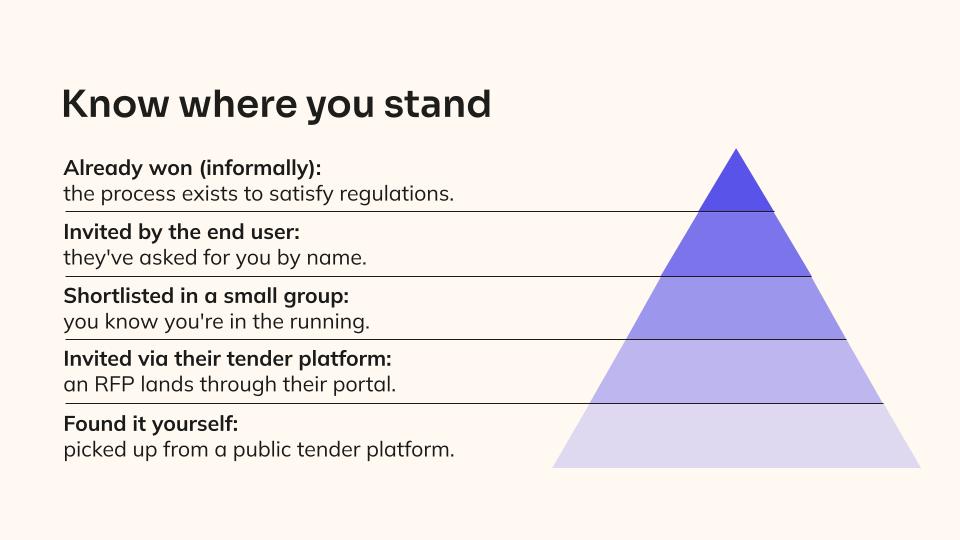
My rule of thumb is that a ‘level one’ wins around 80% of the time and level five around 5%. The further down the ladder you are, the lower your chances.
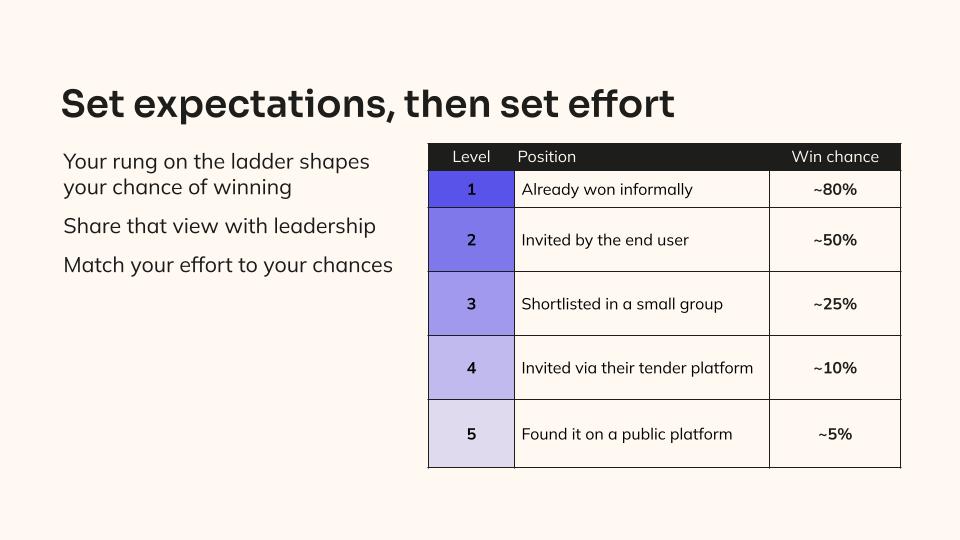
Side note: Those ‘stats’ are based on nothing more than having been through the process many times. I have no studies to back this up, you’re just going to have to go with me here. Does it sound about right in your experience?
So set expectations in your own head. Set them with your leadership too. And ask honestly whether it's worth the effort.
One engineer in the room took this further. The voice in the room said to treat this like a risk assessment, but for opportunity. The maths are this: the chance of winning multiplied by the value of the work. A £1m job at 5% is worth about the same as a £60k job at 80%. That's a quick, very engineering-minded way to decide where effort should go.
Bid or no bid?
We’re all busy and we must defend our time to keep on the high value tasks. Every bid you write is time not spent on something else.
Years ago, a £100k RFP landed on my desk at 3.45pm on a Friday. At the time, in that business we were up against it. We were behind on revenue and badly needed a new win if we had any hope of hitting the quarter. So, with that context, I read the incoming RFP, shut my laptop and went home. I wish I could say it was an easy baller move. It wasn't, but it was the right call.
My good friend Alex and I wrote about this in depth in To RFP or not to RFP, that is the question. Alex's four questions are a good place to start.
- Does it fit where we are, and where we want to go?
- Do we have the conditions to write a good bid? Is the brief clear? Is the budget and timeline realistic? Do we have the people to write it properly?
- Do we have the resources to deliver it?
- How likely are we to win? Who else is bidding, is there an incumbent, and what makes us different?
The room challenged question three. We know that in large infrastructure engineering projects start dates almost always slip. The original dates and resourcing demands can be all over the place. I’m not saying planning proper resourcing isn’t important - that would be rash - but, with a little bit of confidence, it's rarely the reason to say no.
I added two more points to consider when making the bid or no bid decision.
The first is the deadline rule.
“Put simply: The shorter the deadline, the less likely you are to win.”
A Friday afternoon RFP that is due Monday morning usually means you're the third or fourth quote.
The second is context can be king.
Sometimes it's worth bidding anyway. If it's a client you've chased for years, a sharp bid can open a door. After all, the only bid you definitely don’t win is the one you don’t write. If you are going down this route for the prize unicorn client then leadership should tell the team why. People write better when they know the reason.
Decide fast, then kick off
There's a natural habit of leaving a six-week bid until the last two weeks. But clarification questions often have to go in during the first fortnight. Miss that window and you lose your best chance to shape the bid.
So decide quickly. Then get the senior person who received the bid on a call with the bid team. Share why you're going for it, what you know about the client, and what you've heard on the grapevine. Even the most technical section is part of a sales document. Everyone writing needs that context.
Tilt the odds
The more you know about what matters to the client, the more tailored your bid can be. So gather intel, through every route you can.
Work your champion
Your champion is the friend inside the business. Someone you've worked with before, who wants you to win. Ask them what they want to see, and what they don't. What have they tried before? What's worked? Then tailor the bid right down to it.
A word of warning: Relying on one person is high risk over the long term. Build relationships across the business.
Once a tender is live, respect the rules on contact. Many developers will disqualify a bid for talking out of turn. The best time to build a relationship is before the tender drops.
Find the real decision maker
This came from the room, and it's a good one. The person you deal with day to day isn't always the person who decides. You can spend hours with a bid manager who won't make the final call. Nobody will tell you who does. It takes some detective work, but it's worth knowing.
Use the formal routes too
It’s important not to neglect the basics. While the bid may be under time pressure it is important to read every document and use the clarification process.
One sometimes overlooked point is finding out the rules of engagement. How much weight goes on price, and how much on quality, innovation or experience? Large tenders usually state it. Even then, dig deeper. Is the price a lump sum, or day rates? Or are they open to other pricing structures? Are the options scored? Your competitors will be asking the questions.
Write it well
I promised this wouldn't be a guide to writing bids. But a few basics come up again and again.
Walk in the buyer's shoes
Have you answered the question? It sounds obvious. It often doesn't happen.
One engineer summed it up beautifully. Make the evaluator's life easy. If they list ten points, answer them in the same order, using the same words. If they ask for a foundation engineering consultancy, don't pitch them a foundation design service. It may be the same thing to you, but it isn't what they asked for.
Think you know a better way? Say so, but carefully. Answer what they asked for first, in full. Then offer the better way as an option alongside it. Shaping what they need is work for before the tender, not during it.
And tick every box. Documents, insurances, qualifications. Miss one, and a strong bid can fall at the first hurdle.
Don't neglect the exec summary
It's deadline day. Everyone's tired. And the last thing written is the exec summary, thrown together in a rush.
That's backwards. The exec summary is the first thing the client reads. For some of the people deciding, it's the only thing they read. So give it real time. Tell a story: the challenge, your approach, the result. Talk about the impact on their project, not a list of tasks. And name drop. Be clear about where you've done this before. If you're unsure what you can say about past clients, check, but lean towards saying more.
Reuse the good stuff, then check it
I am an advocate of having stock copy ready to go - boilerplate isn't a bad thing. Introductions, case studies, CVs, terms and conditions. Don't reinvent the wheel every time.
A simple start is a shared folder of your most recent winning bids. But don't be lazy with it. Make sure it fits this bid. And check it. Nothing says "we don't care" like another client's name in your proposal. One engineer admitted he once opened a file called standard T&Cs late at night, and only just caught that it still needed the client's name and scope. Ctrl+F is your friend.
Get it checked
At Make the Break, we have developed an internal SOP that every proposal goes through a four-layer review before it leaves the building.
- Critical errors. Typos, wrong names, inconsistent numbers and dates.
- Have we answered the question? Every requirement checked off.
- Clarity. Plain words, evidence over adjectives.
- Will it win? Impact, proof, and no promises we can't keep.
A tool like Grammarly helps with the first layer. But nothing beats a colleague reading it with fresh eyes. Within Make the Break, we have purposely built a culture of peer review. We have a Slack channel dedicated to bids and we openly ask for peer review. If you know my team, you’ll know they are not shy about giving frank and honest feedback!
What about AI?
We're all using it, so let's talk about it. On the day of the talk, I sorted it into a simple traffic light.

Green: good idea
- Brain dump out loud. I talk far more than I type these days. I'll spend an evening telling Claude everything in my head about a project, with strict instructions not to write anything yet. It gets me from a blank page to structure much faster. This talk started that way.
- AI as your paralegal. Let it take the first pass through the tender pack. What's relevant, what's being asked for, and where the documents contradict themselves. Those contradictions make great clarification questions. It won't replace your technical eye, but it gets you going.
- AI as your proofreader. Spelling, consistency, and above all, have you answered the question? One engineer asked AI to review his draft, and it pointed out he'd spent too long talking about his firm and not enough on the client's problem. That's a useful nudge.

Amber: good idea, with caveats
- Check before you upload. Tender documents are often confidential. Some clients won't want them going into a cloud tool. Check the terms, and use a tool your business has approved.
- Market and competitor insight. AI can pull insight out of big industry datasets very quickly. But check every figure before it goes anywhere near a bid.

Red: not such a good idea
- Letting AI write your answers from scratch. There's a big step between reusing your own best material and generating fresh content at scale. It can read like AI. It can get technical detail wrong. And it can make things up, which is dangerous when bid content often ends up in the contract.
This one sparked the best debate of the day. Some in the room pushed back hard. Their view was that AI writing is now very good, if you feed it well. And as one person put it, this isn't an exam. Why does it matter if a bid had help?
It's a fair challenge, and the tools are getting better fast. But we still see drafts every week (within our own work and our clients’) with giveaway signs, staccato sentences and straight hallucinations. It’s a moving scene but our counsel is to be careful. If you use it, make sure you can stand behind every word, and that every promise is one you can keep.
Go further
Land it well
Deliver on time, and if you can a little early. We do not want to be the bidder who always asks for an extension.
Then think about the email it goes out with. Too often it's "please find attached", written at the end of a long day. I firmly believe this is a huge missed opportunity. Instead, think of the cover note as an extension of your exec summary. Land your biggest point in the first lines and tailor it to who's opening it. A technical lead wants to know where their ten points are answered. A project lead wants to know what changes for their project. Talk to them in their language.
Change the format
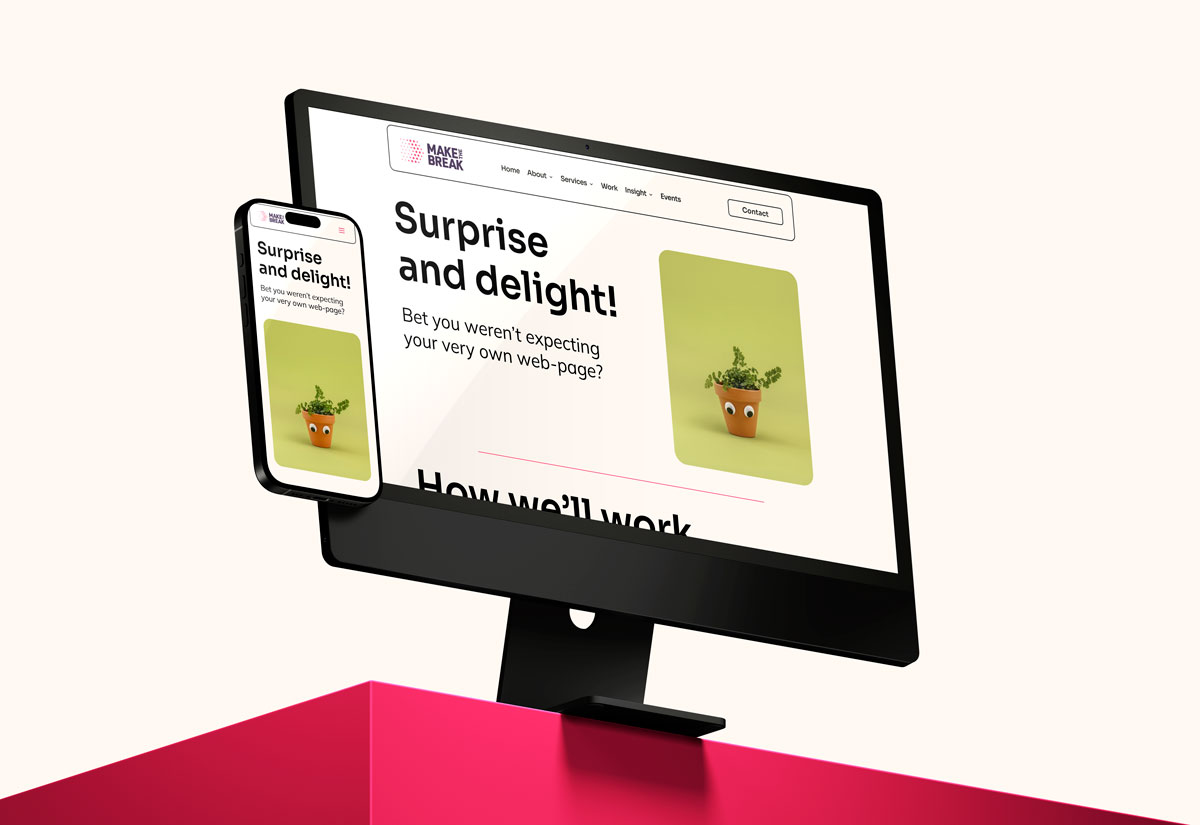
Everyone expects a PDF. For our bigger reports and proposals, we've started doing something different. We send a link to a web page where the client can download the document. Next to it sits a short video of us walking through the main points.
It stands out and it puts a face and a voice to the work. The analytics tell us the videos get viewed so we are potentially unlocking our proposal with people who would never read a 40 page PDF. A caveat: we are not suggesting this as a blanket policy and we fully recognise it won't suit every tender, especially those which must go through a formal portal. My point here is that there are other ways to deliver than an email attachment. Why not try something a little different?
Make the next step easy
I have a phrase for this. Never make the client chew calories to work with you. It’s within your control to be clear about what you’re asking for, what happens next and when.
One simple trick from the room. Add an acceptance section to the proposal: a name and a signature, and that's it.
Follow through
Secure the follow-up
Submitted? Good. Now get the next conversation in the diary. If you're on a call with them, book the next one there and then while calendars are open. Hardly anyone says no to that live on a call. If you send the invite by email the next day the likelihood is it will get ignored.
As much as you can, don't leave the next step with them. Instead, be bold and suggest it. "Let's speak on Friday" gets things moving faster than "let us know your thoughts".
Work the back channel
Go back to your champion. Is there any early feedback? Is momentum moving towards you or away? Is there another stakeholder worth a conversation? Again, respect the rules while the evaluation is live.
Don't be shy
If it all goes quiet, chase. And chase again. It can feel awkward. But you decided this bid was worth doing and your team put hours into it. You're allowed to ask where it's at. There's an old phrase I love: no sweeties for shy kids.
Didn’t win? Get the feedback
If you lose, always ask for a feedback session, and push for honest, unfiltered answers. It's not fun. But you don't know what you don't know. The reason you lost might be easy to fix next time around. It could be something as simple as an incorrectly formatted document or the wrong part of an insurance highlighted.
I recommend putting the lessons alongside the winning bids, into a shared folder. The idea here is that every bid should make the next one easier.
So why was I there?
None of this needs an engineering degree, and that's exactly the point.
In summary, choose your battles because a few good bids beat lots of bad ones. Tilt the odds before you write a word. Write it well and get it checked. Go further than the minimum. And follow through, win or lose.
On your next bid, pick one of these and do it differently. Then let me know how it goes.